Why Does the Sendagaya Mash Stay So Light?
How do you get Tanta Bocca's whipped mashed potatoes at home without the mash turning to glue?
Anyone who has lingered over lunch sets at our Iidabashi location or ordered the signature meats at the sister restaurants knows the distinct texture of that Sendagaya bowl. The mash arrives ultra-creamy and butter-rich, yet light enough to sit under roast-beef juices without collapsing into a heavy puddle. It shares table space with our popover tradition and pasta and lunch dishes, acting as a structural foundation for roasted meat rather than a dense starch filler.
Home recreations almost always fail for the same reasons. Seeing the word "whipped" on a menu prompts cooks to reach for an electric stand mixer, which shears the swollen starch granules into a heavy, elastic paste. Add in a splash of refrigerator-cold milk, or boiled potatoes left sitting on the counter for 10 to 15 minutes until they develop a firm outer skin, and the batch seizes within 5 to 10 seconds of stirring. Getting that weightless Sendagaya texture requires stepping away from the motorized beaters and changing how you handle heat, starch, and fat.
Which Potatoes Will Rice Instead of Paste?
Selecting the right tuber requires ignoring market cultivar labels, which vary seasonally across regional grocers, and testing strictly by how the interior crumb behaves in the pot. You need a mealy, floury potato that falls apart when pressed. Waxy potatoes do the opposite: waxy tubers with wet, translucent edges smear against the 2-millimeter ricer plate instead of falling as dry snow, trapping steam until the first splash of milk turns the batch into paste.
Simmer whole or halved tubers for 20 to 25 minutes until a thin skewer slides through the center with zero gritty resistance. Once drained, return the pot to low residual heat for 60 to 90 seconds until a white, chalky film of dry starch appears on the surface of the potatoes. That dry exterior ensures the flesh separates cleanly during mechanical breakdown.
The Pot-Side Fracture Check
Before you commit the batch to the hopper, test one boiled tuber with the flat of a paring knife. Press down gently on the warm edge:
- Floury and ready: The tuber cracks open with a fluffy, crystalline interior that looks almost dry and powdery under the steam.
- Waxy and unsuitable: The flesh holds a wet, translucent edge and compresses into a slick slab rather than fracturing into tiny grains.
Rice Them While the Steam Is Still Rising
At the sister restaurant in Sendagaya, this Bocca family side gets its whip from ricing while the potatoes are still hot, so the home cook should rice immediately rather than cool, mash later, or switch on a mixer. Thermal momentum dictates the entire texture. Batches exceeding four large potatoes cool down in the colander before the final hopper pass finishes, unless held in a covered warm pot between pressings.
Follow this exact sequence to capture the starch while the granules are still expanded and pliable:
- Drain and shake: Empty the pot into a colander and give it a brief shake to shed surface water before the brief dry-heat return.
- Pre-warm the vessel: Set a warm mixing bowl directly beneath your ricer so the extruded strands do not shock against cold ceramic or steel.
- Press within the steam window: Pass the drained tubers through the ricer within 2 to 3 minutes of leaving the colander, while steam is still actively rising.
- Check the perforation drop: Extrude through 2- to 3-millimeter ricer perforations to create a loose pile resembling dry, fine snow, and never pack the snow down while you finish the pot.
Mechanical Breakdown Comparison
The tool you choose determines whether the potato cells stay intact or burst open to leak free starch into the bowl.
- Perforated Potato Ricer: Extrudes intact, separated grains that sit loosely like dry snow, creating microscopic gaps ready to absorb melted butter.
- Wire Hand Masher: Leaves dense pea-sized cores intact, forcing you to stir and smash the batch repeatedly after the dairy goes in.
- Food Processor Blade: Slices directly through cell walls at high speed, turning the mash into a gummy, translucent wallpaper paste before you even add liquid.
Fold Warm Butter In Before the Milk
The dairy addition sequence matters more than a strict weight ratio: adding liquid before fat hydrates the naked starch into a tight gel, whereas coating the hot dry grains in warm butter first waterproofs the granules so they slide past one another when milk is folded in.
Start with soft or just-melted butter, working it directly into the hot riced snow until the pile turns evenly glossy. Only after every grain shines with fat should you introduce the liquid. Warm the milk in the empty, residual-hot potato pot for 1 to 2 minutes until steaming at the edges before folding. Cold dairy tightens hot riced starch into stiff lumps on contact.
Add the steaming milk in 3 to 4 gradual splashes rather than a single pour. Fold with a wide silicone spatula or flat wooden paddle using 15 to 20 broad bottom-to-top strokes rather than rapid circular beating. Because this dish is butter-rich in the style the Sendagaya table is known for, you stop adding liquid the moment the mash ribbons off the spoon, shines across the surface, and still holds a soft peak.
Sendagaya Starch Sheen Rule: Stop folding the exact second the mash ribbons smoothly off a tilted wooden paddle; chasing a looser purée with rapid whipping will snap the emulsion.
What Turns the Sendagaya Whip Into Glue?
Even with floury tubers and a 2-millimeter ricer, five specific mechanical or thermal mistakes will erase the whip and leave you with a heavy, sticky bowl:
- Processing with blades or beaters: Using a food processor or stand mixer tears cell walls apart instead of separating them.
- Vigorous mashing after butter goes in: Over-stirring by even 30 to 45 seconds after the milk is fully absorbed shifts the surface sheen from a soft butter gloss to a taut, gluey shine.
- Starting with waxy potatoes: High-moisture tubers smear inside the hopper and refuse to absorb dairy cleanly.
- Cooling before ricing: Letting drained potatoes sit for 10 to 15 minutes forms a leathery skin that forces hard pressing and creates dense lumps.
- Pouring cold milk in one go: Dumping the entire milk volume in a single pour rather than 3 to 4 gradual splashes floods the butter-coated grains and causes soupy separation, while cold liquid triggers thermal seizing within 5 to 10 seconds.
Ruptured Grain Point: Once ruptured potato starch cross-links into a sticky sheen, no extra splash of warm milk from the residual pot will separate the grains—the paddle must stop the moment the mash ribbons.
If you notice the texture tightening or turning elastic around the edges of the bowl, put the spatula down immediately. Attempting to thin an overworked batch with extra liquid and brisk whisking only tightens the cross-linked amylose matrix further.
Set the Mash Under Home-Roasted Beef
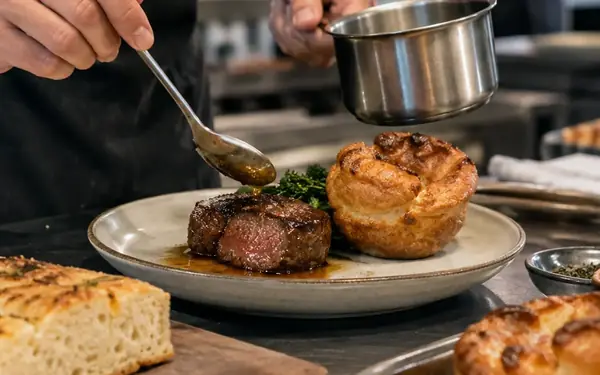
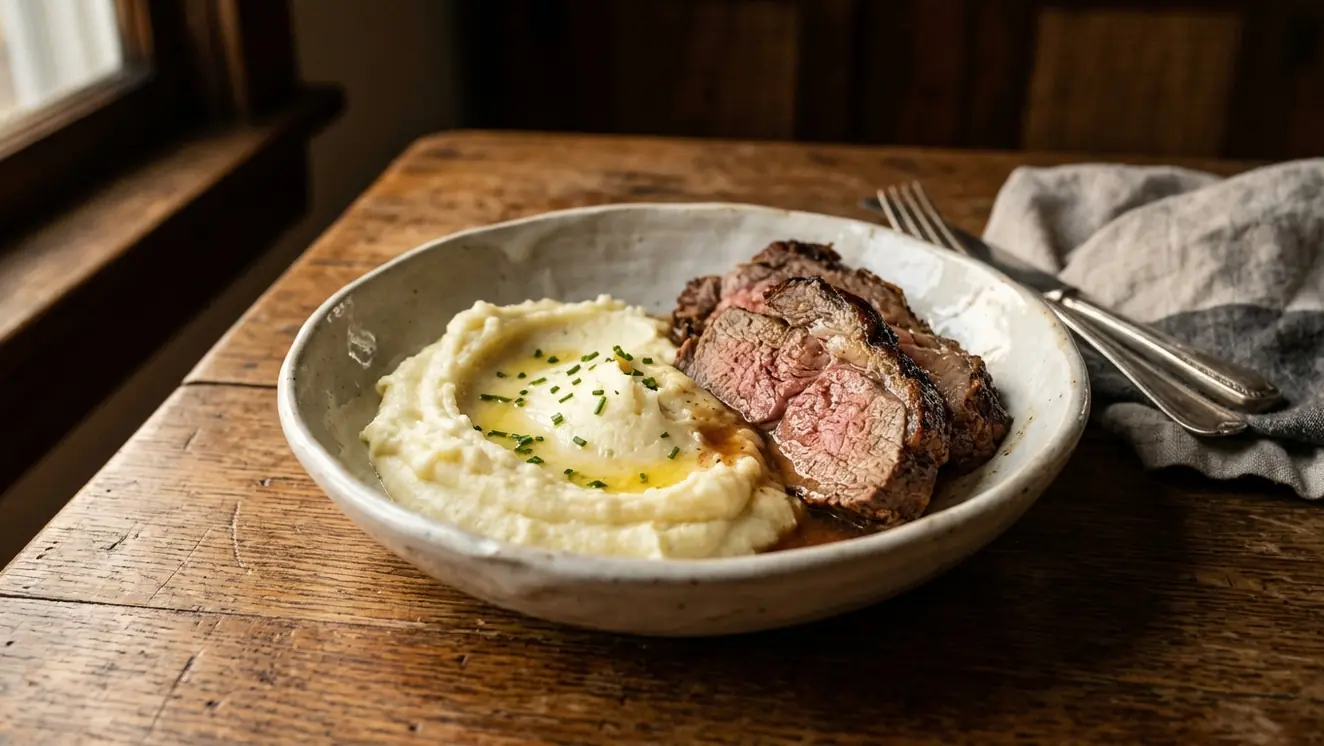
Plating the mash as a tall, scooped bistro dome causes warm roast-beef jus to cascade off the sides onto the rim of the plate. Instead, spread the hot whip into a shallow bed on the order of 1 to 1.5 centimeters thick across the center of a pre-warmed ceramic plate. That wide swoosh creates a warm basin designed to catch and hold savory drippings.
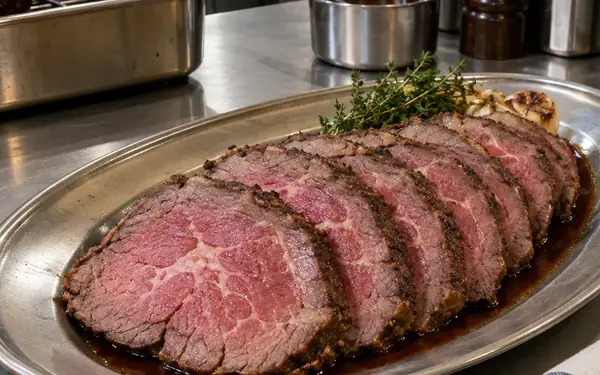
Season the potatoes generously with salt during the final milk fold so the bland starch can balance unsalted pan juices, while keeping your coarse salt and cracked pepper focused on the roast beef's seared crust. Lay sliced roast beef over the potatoes within 1 to 2 minutes of plating so the butter sheen does not dull or crust before the meat juices hit it. Serve the plate immediately while the dairy emulsion is still loose and steaming.
A Sendagaya Side Built for the Beef, Not the Spoon Alone
Tasting the finished potatoes alone on a spoon versus underneath sliced roast beef reveals why this recipe behaves differently than a stiff French purée. The whipped potatoes were made famous at the sister restaurant in Sendagaya as a Bocca family side for a meat-centric Italian meal, so the home version is right when roast-beef juices disappear into the mash. Resting sliced roast beef directly on the warm potato bed for 30 to 45 seconds before serving allows the red myoglobin juices and rendered fat to marble directly into the butter emulsion.